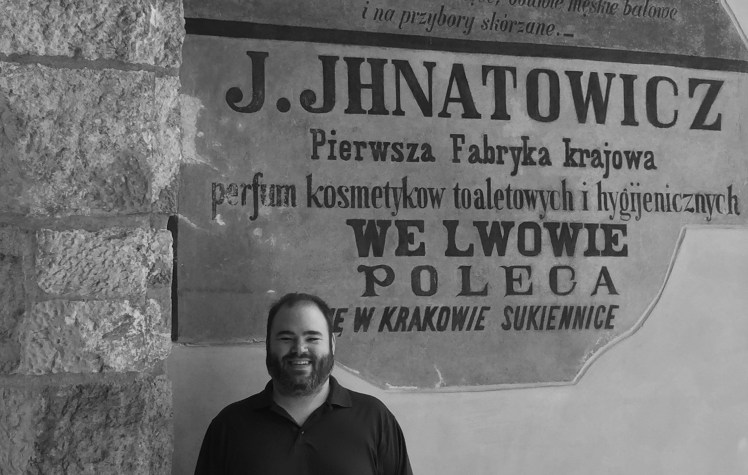
Photo: Advertisement Reproduction, Sukiennice (Cloth Hall) Wall, Rynek Główny, Kraków. Credit: L. Navarrete-Burks.
Current Research
In recent research, I have utilized approaches from social and cultural history, urban history, and advertising theory, to examine everyday life in the urban environments within the region of Galicia. More precisely, my work explores advertising in the popular daily press as an indicator of social and cultural trends from 1911 to 1921, across the First World War. Doing this allows me to make observations about aspects of life and culture that develop in prewar Galicia, then a region within the Austro-Hungarian Empire. I then observe how those aspects of life both changed and persisted across the war years and the turbulent years of the early interwar period.
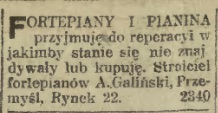
Piano Advertisement, Ilustrowany Kuryer Codzienny, No. 77, 23 June 1918, page 8.
One such aspect is the economic and social mobility of different groups within the middle class during the war years. The continued presence of piano advertising allows me to show the importance of the piano as a symbol in Galician culture, and to make important conclusions about the fluid nature of the middle class. This research recently appeared in The Austrian History Yearbook‘s 2025 issue.
I also use marriage classified advertising to show how marriage culture in Galicia used this medium as a means of social communication from the prewar years into the early interwar period. Newspaper advertising in Lwów and Kraków (which emulated British and German advertising, which, in turn, had been modeled on American advertising) both for commercial and personal uses, is an area of everyday life that withstands the disruption of war. While my research does not strive to change the narrative of war as a disruptive and tragic event, I postulate that observing aspects of everyday life that persist forces us to be more nuanced in our understanding of how people, societies, and cultures interact with war and instability. This allows us to observe overarching themes that do not end or begin with the dates that often bookend our discussions of historical trends in the early twentieth century.


Maps: Galicia, Austro-Hungarian Empire (Galicia in the top right), and Interwar Poland, Open Source (click to enlarge).
Future Research
I have recently begun extending my previous work to comparatively examine advertising in newspapers from other cities in partitioned Poland (Poznań, Warsaw, Łódź, and others) alongside the cities that I have already examined (Kraków and Lwów). I believe that tracing the trends in advertising in these cities as the states they resided in began to fail (the German Empire, the Austro-Hungarian Empire, and the Russian Empire) will provide insight into the nature and development of print and consumer culture in Polish speaking lands.
Additionally, I am broadening my examination of marriage advertisements to include both newspaper advertisements and marriage-focused publications in Kraków, Lwów, and other major cities in Poland, moving into and across the Interwar Period. I hope to further examine how marriage trends might have been impacted during that uncertain time.

 Drew Patrick Burks